


Financial Management with Account Aggregator
Regulated by the Reserve Bank of India (RBI). Your data is secure and under your control. Choose what to share.


Exit


STEP 1
Identity Proof

STEP 2
Business Proof

STEP 3
Bank Proof
Verify your GST Number
Enter the 6 digit code you received on your registered number.

Resend code in 29s
1
2
ABC
3
DEF
4
GHI
5
JKL
6
MNO
7
PQRS
8
TUV
9
WXYZ
0

Exit

STEP 1
Identity Proof

STEP 2
Business Proof

STEP 3
Bank Details
Bank Details
Looking for bank accounts linked to your phone number +91 123456789.
Simplifying MSME onboarding
Designing a verification and consent experience for MSME lending.
Our bet was to make loans more accessible for small businesses by reducing the paperwork and repeated verification involved in applying. I worked on the merchant onboarding journey to simplify the identity and business verification steps and help merchants securely share their bank data with lenders.
The goal was to reduce friction and build trust in a process that was unfamiliar to many business owners.
- Role
- Product Designer (freelance)
During my first year of college, receiving my first stipend ignited my interest in investing. This curiosity soon expanded to exploring Indian fintech platforms like Paytm, PhonePe, Groww, and Zerodha, and understanding the technology that powers them.
Since then, I’ve always been keen on working on a fintech product. I recently worked with a few founders of BharatX to design a product for MSME lending.
During the design process, I faced some roadblocks. They were due to my limited knowledge of the India Stack. With this case study, I intend to explain my design of the onboarding flow and help others understand the India Stack.
Before we dive into solutions, it is crucial to understand the problem we are trying to solve.
Identifying the problem
Our primary goal was to design an onboarding flow that educates users about the Account Aggregator framework. Additionally, we aimed to securely verify their identity and business details while obtaining consent to access their financial information.
Understanding the Account Aggregator Framework and Its Impact on Digital Lending
Digital lending has been transformational in India. It has given instant loans to people with no or thin credit history. It has also gotten rid of the tedious and lengthy paperwork. Here is an example.
Consider a small business owner seeking a ₹10,000 loan. Traditional banks often turn her away due to insufficient credit history. As part of an educational drive, the government visits her town to raise awareness about digital lending and instant loans. Encouraged by this, she decides to try the digital route and receives the funds in her account within minutes.
Previously, the users had to manually gather and share financial data from various institutions. This loop goes on for each new institution. The RBI’s Account Aggregator framework simplifies this by enabling secure, consent-based digital data sharing.
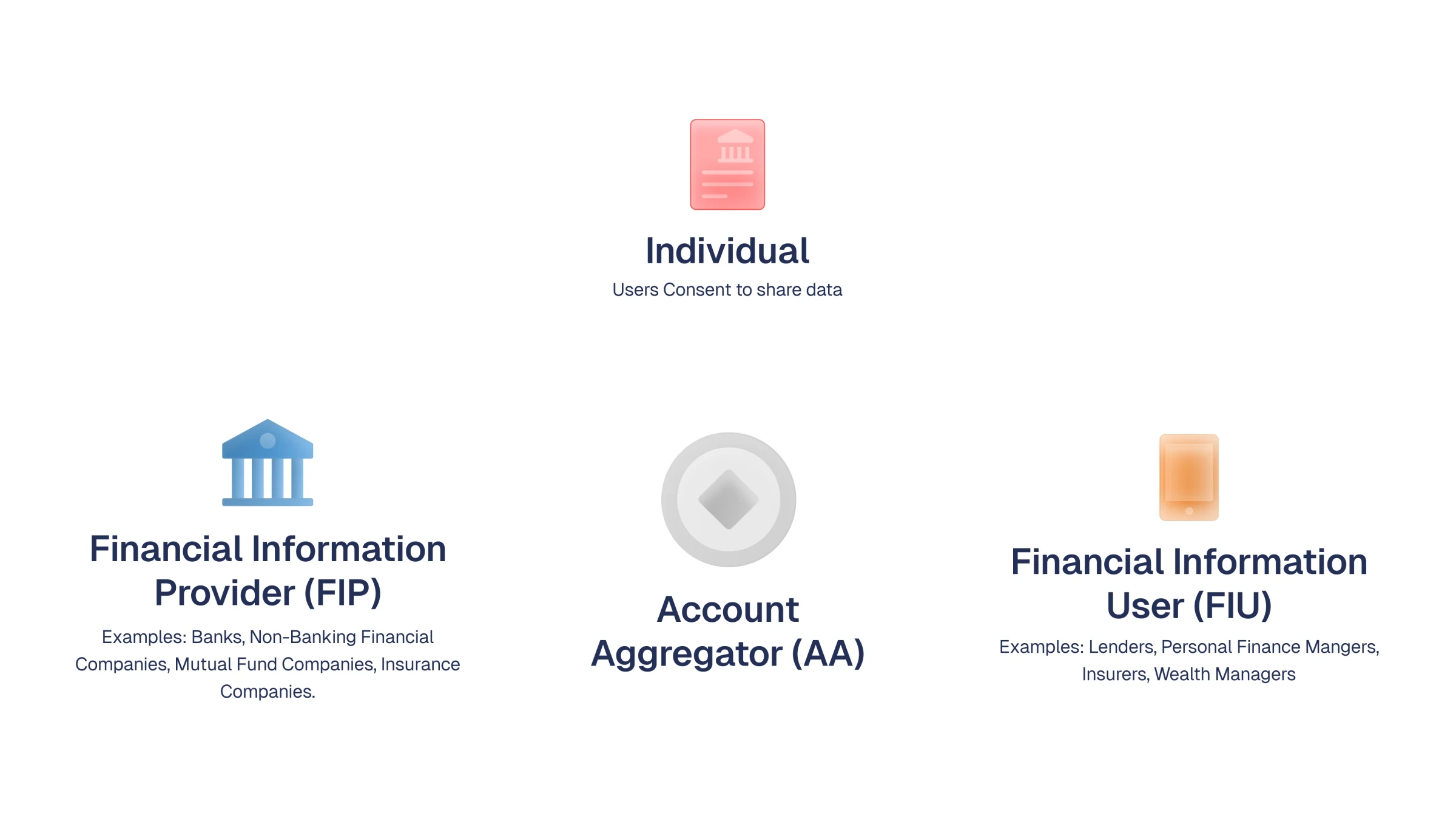
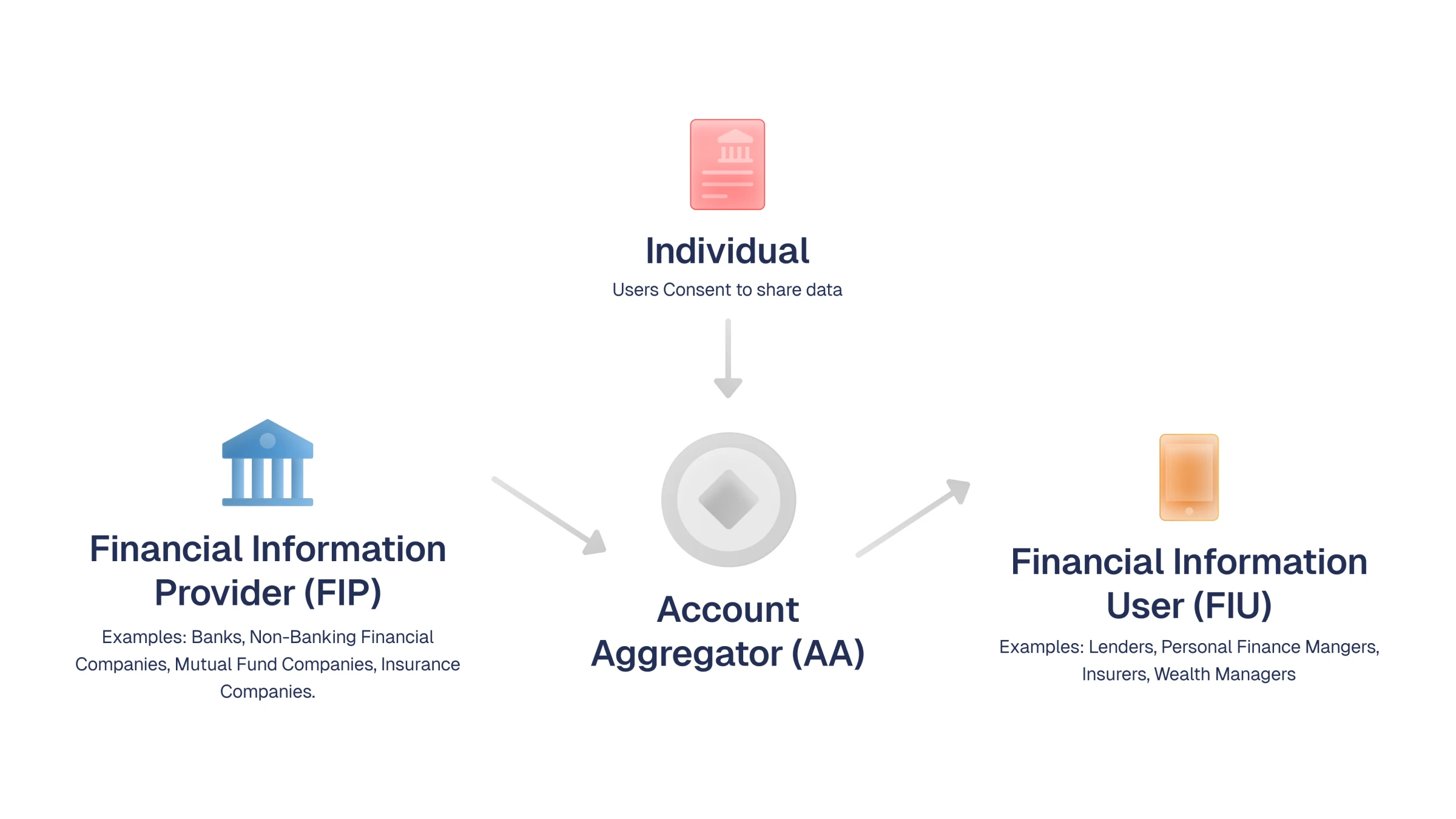
The main participants in the AA ecosystem are:
- Financial Information Provider (FIP): They have your financial data.
- Account Aggregator (AA): Consent managers that deliver data with your consent.
- Financial Information User (FIU): Entities that use your data to provide products or services.
The AAs are a channel between FIP and FIU for transferring information, they do not process it since it is protected by end-to-end encryption (E2EE).
The data here can only be processed by FIU for whom the data is intended and on top of it all the data that is shared is from the implicit consent of the user.
Next, I wanted to learn how people are adapting to AAs. I tried to get feedback from a few people. But, I could not do much primary research. So, I went ahead with secondary research.
I researched AA guidelines, competitor implementations, and articles on data sharing in India. Some of my insights are.
- Most people are unfamiliar with the data-sharing framework. It has eroded users’ trust.
- With the increase in online scams, many users are hesitant to trust apps with their financial information.
- Many OTPs during verification are causing users to drop off before completing onboarding.
- As a new technology, some financial institutions are still adopting it. So, data-fetch failures sometimes occur, causing a poor user experience.
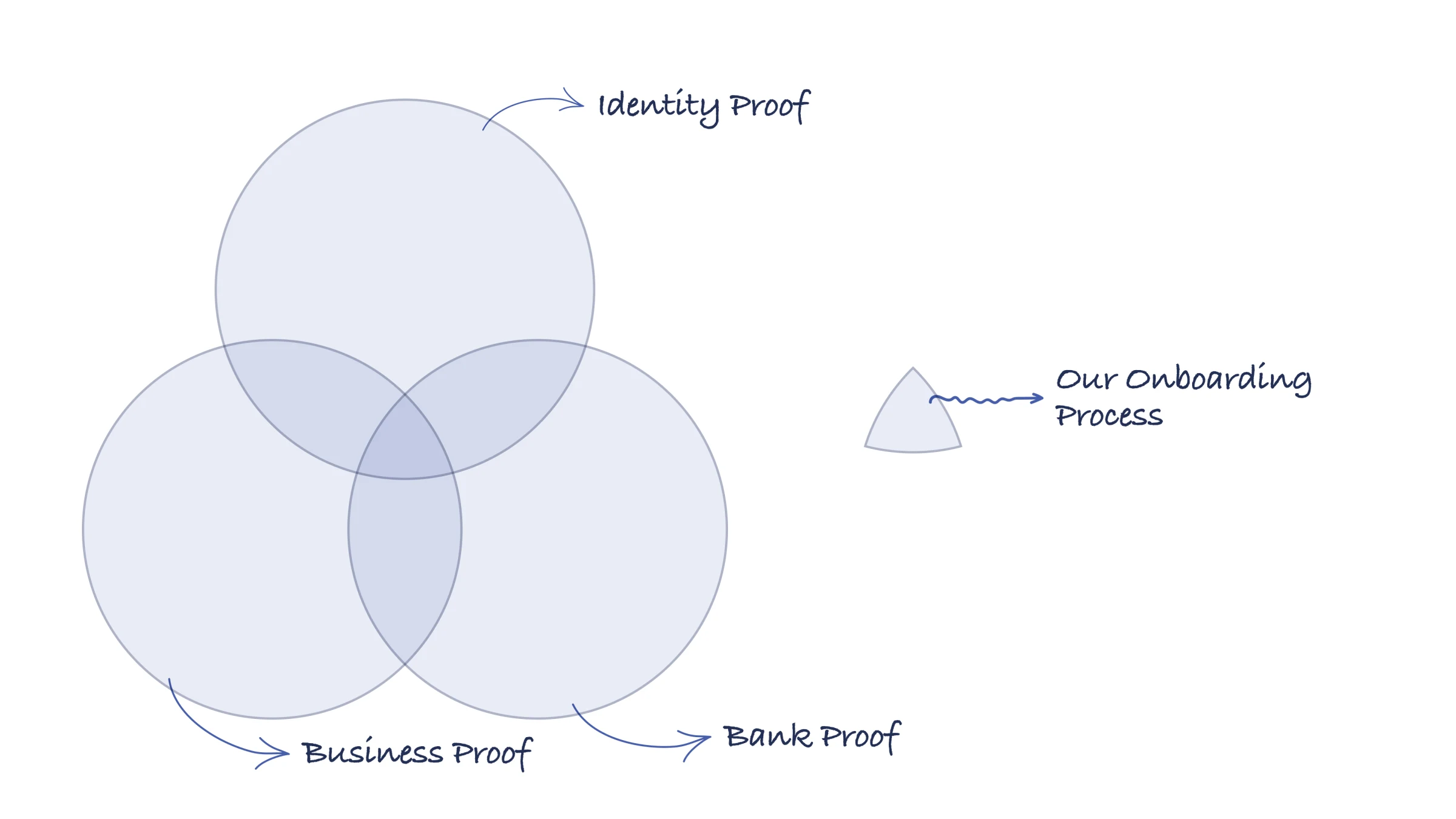
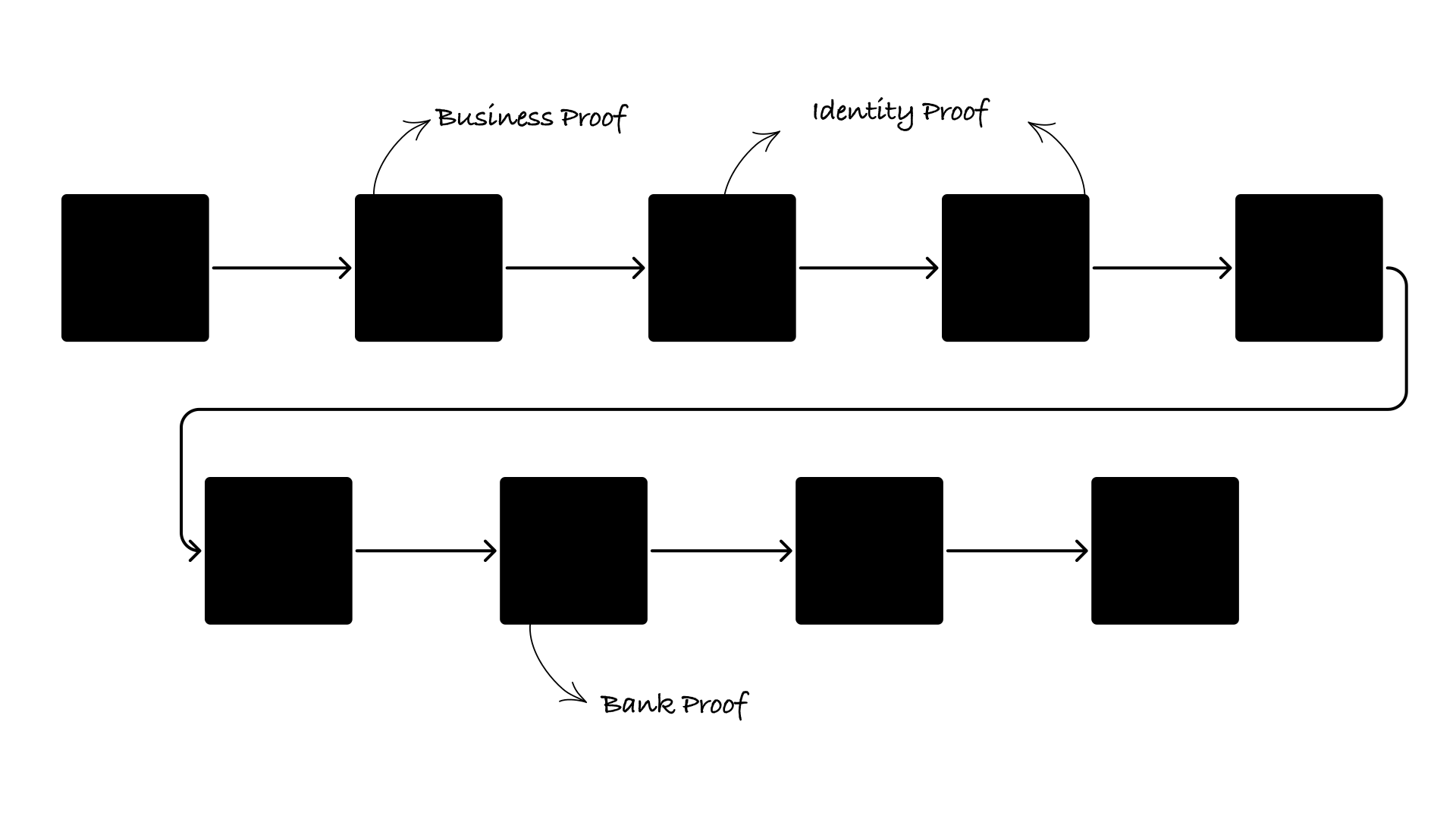
For my particular problem statement, I had to verify a user’s business and identity. They must be a registered business in India. Then, I had to use an account aggregator to fetch their account details. For this, a conventional flow would be.
After concluding my research I defined a design goal with the insights I got.
To create an intuitive, trust-building onboarding experience that ensures transparent and secure verification and educates users on the benefits of the Account Aggregator, leverages the Account Aggregator to auto-fetch users sales and purchase invoices from linked financial accounts.
Before designing, I mapped ways to verify documents with a single OTP. But that was not feasible. However, DigiLoker’s API allows you to verify all your documents in a single step. That is why I decided to continue with this journey. It was viable for the users and for the engineers.
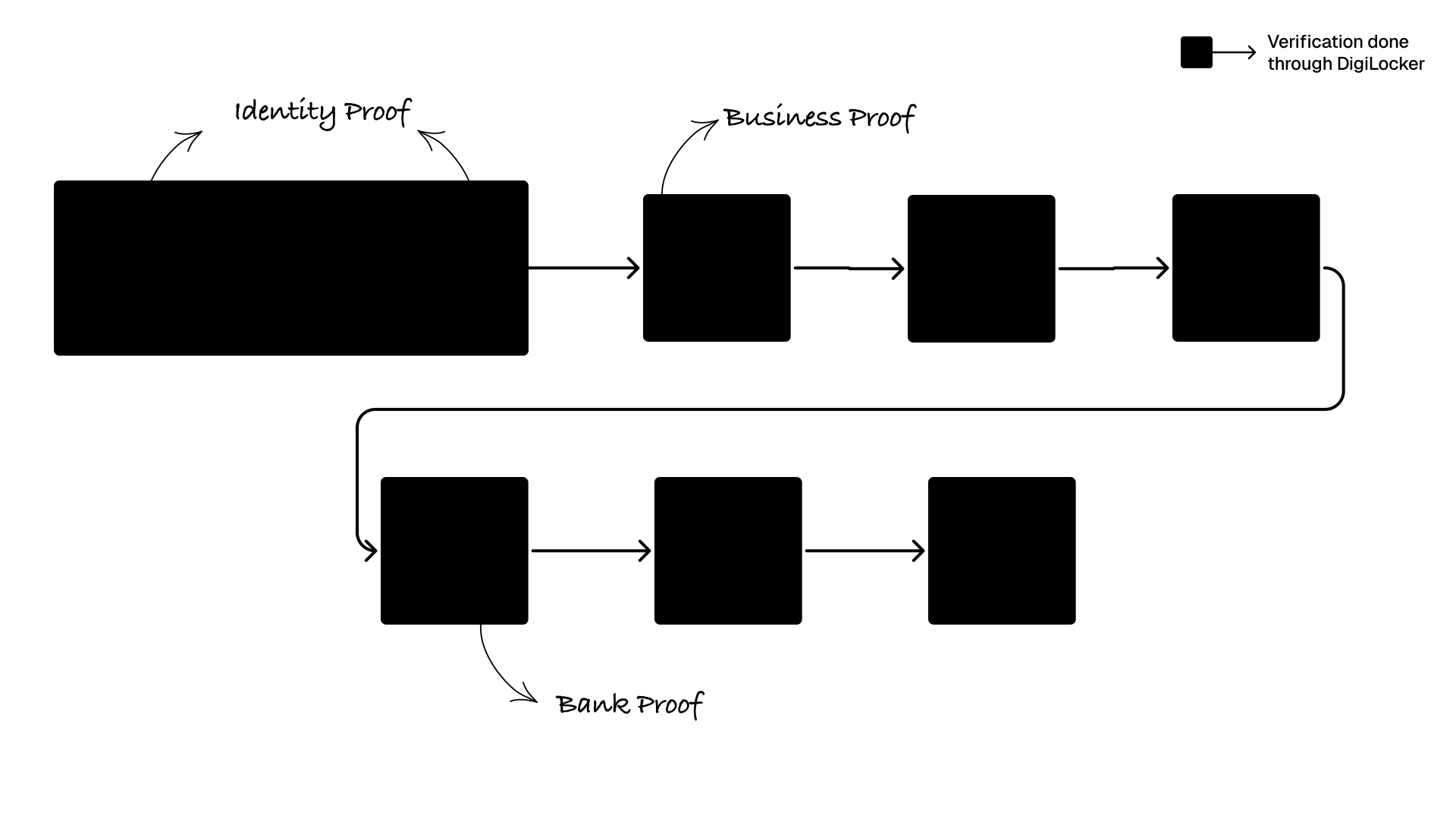
Bringing the flow into existence
Feature-based onboarding
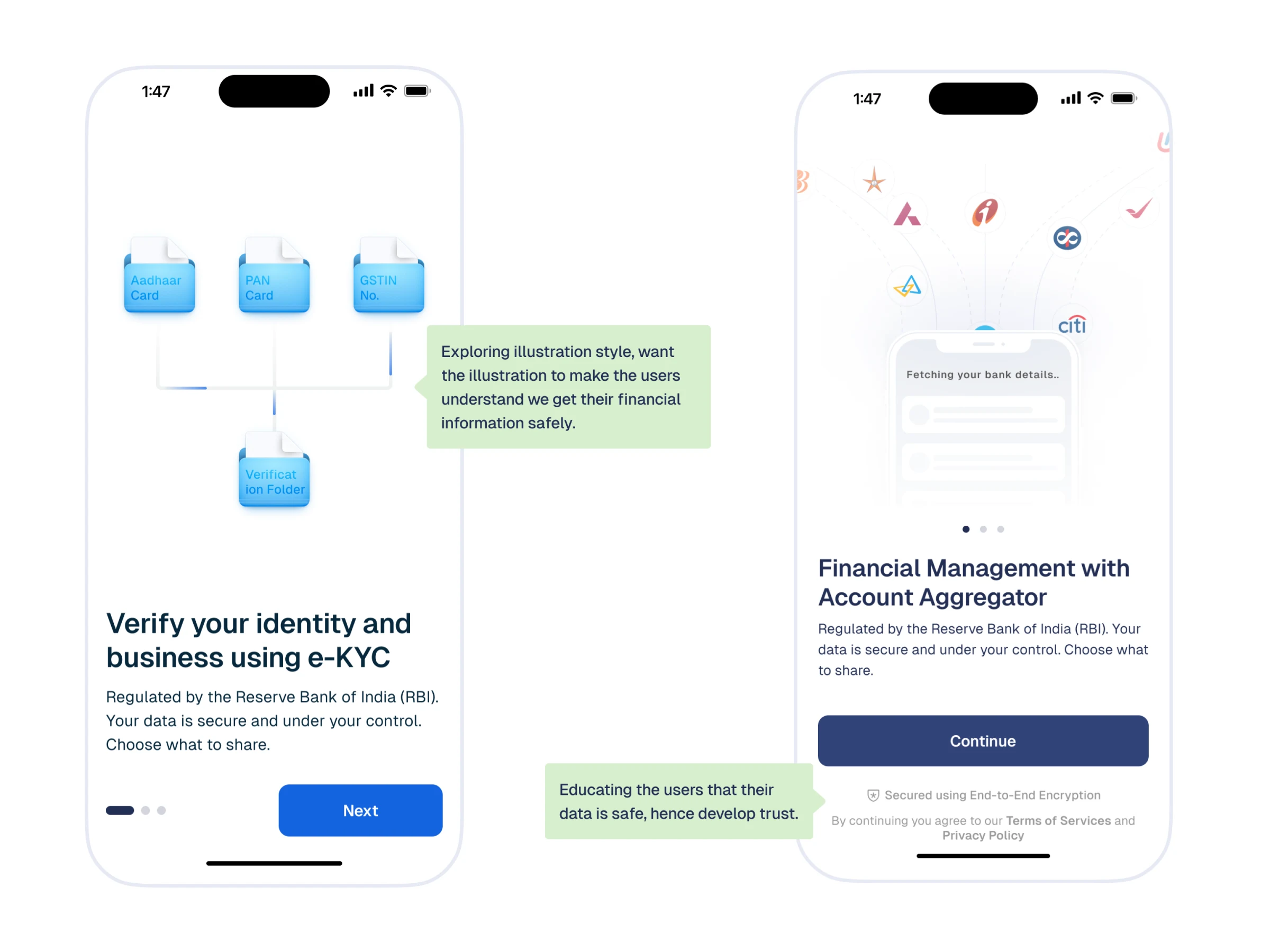
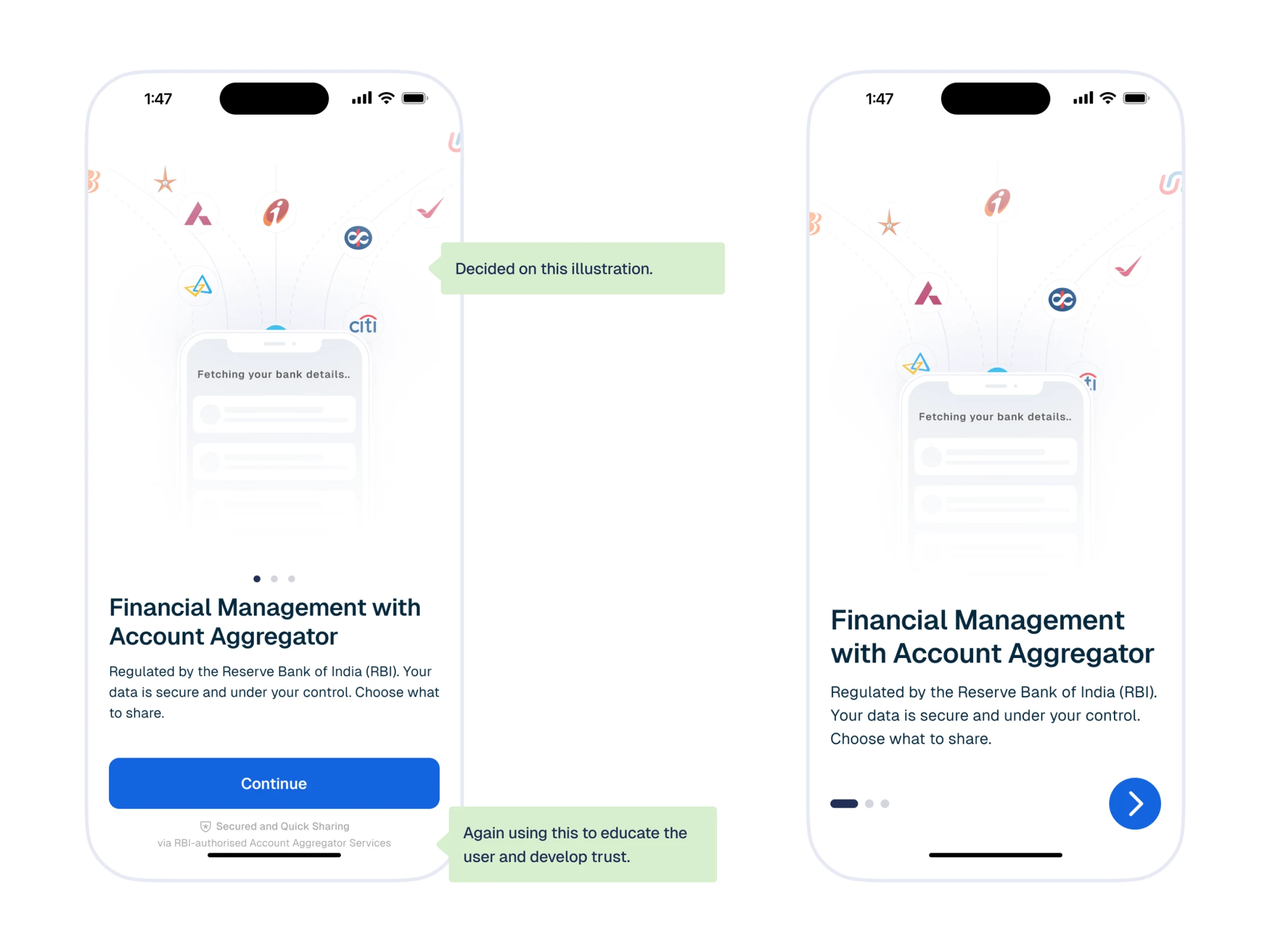
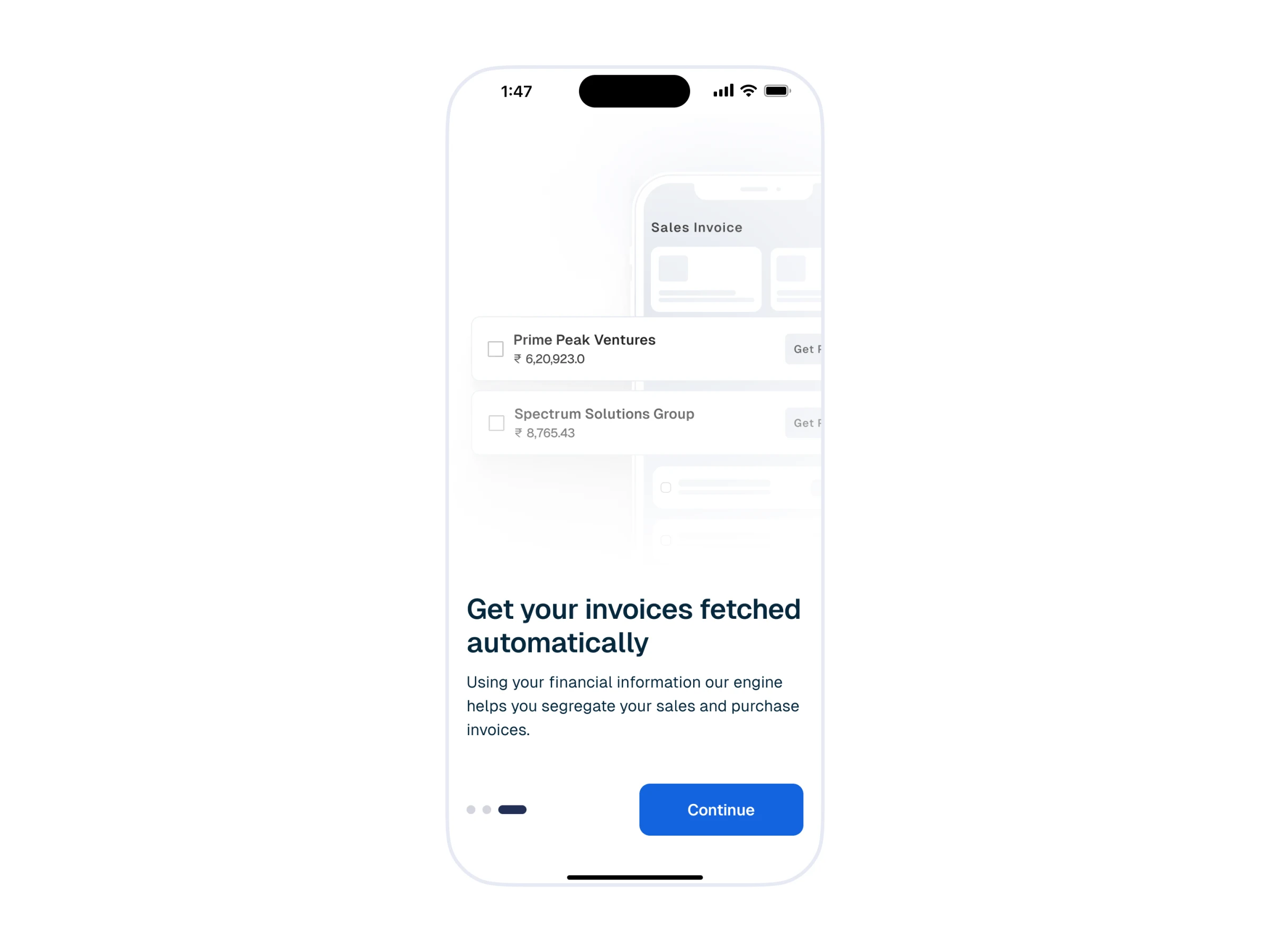
After the splash screen, I wanted the first section to educate the user about AA and e-KYC verification and also highlight our app’s features. Here are a few iterations that I made.
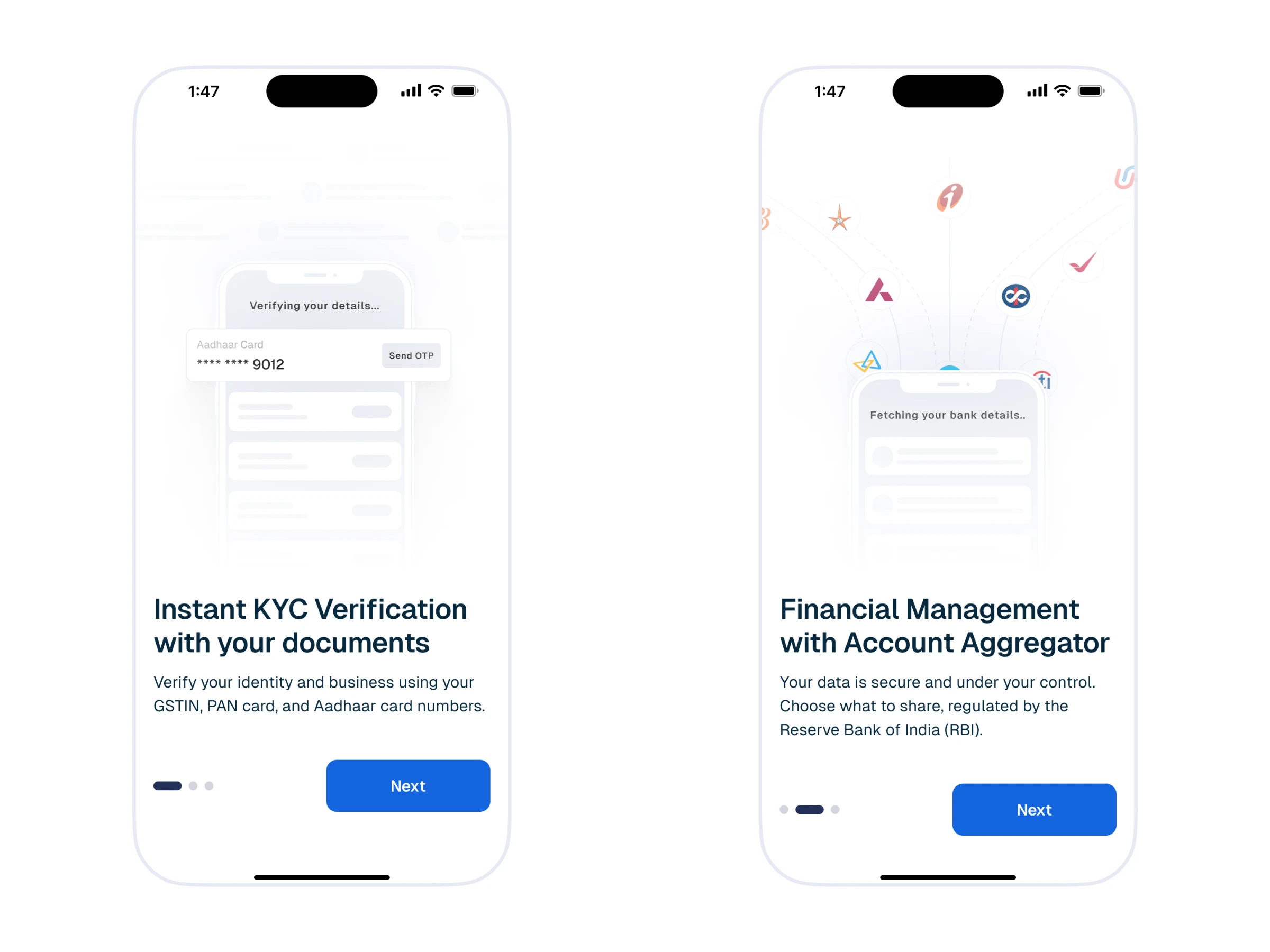
The final screens feature clear, step-by-step explanations and intuitive navigation. Illustrations complement the copy, making complex processes easier to understand.
Identity and business verification
I made my initial designs using the old flow. It had inputs for the PAN, AADHAAR, and GST numbers, followed by an OTP verification screen. The copy also did not help the user understand why we were taking all this information.
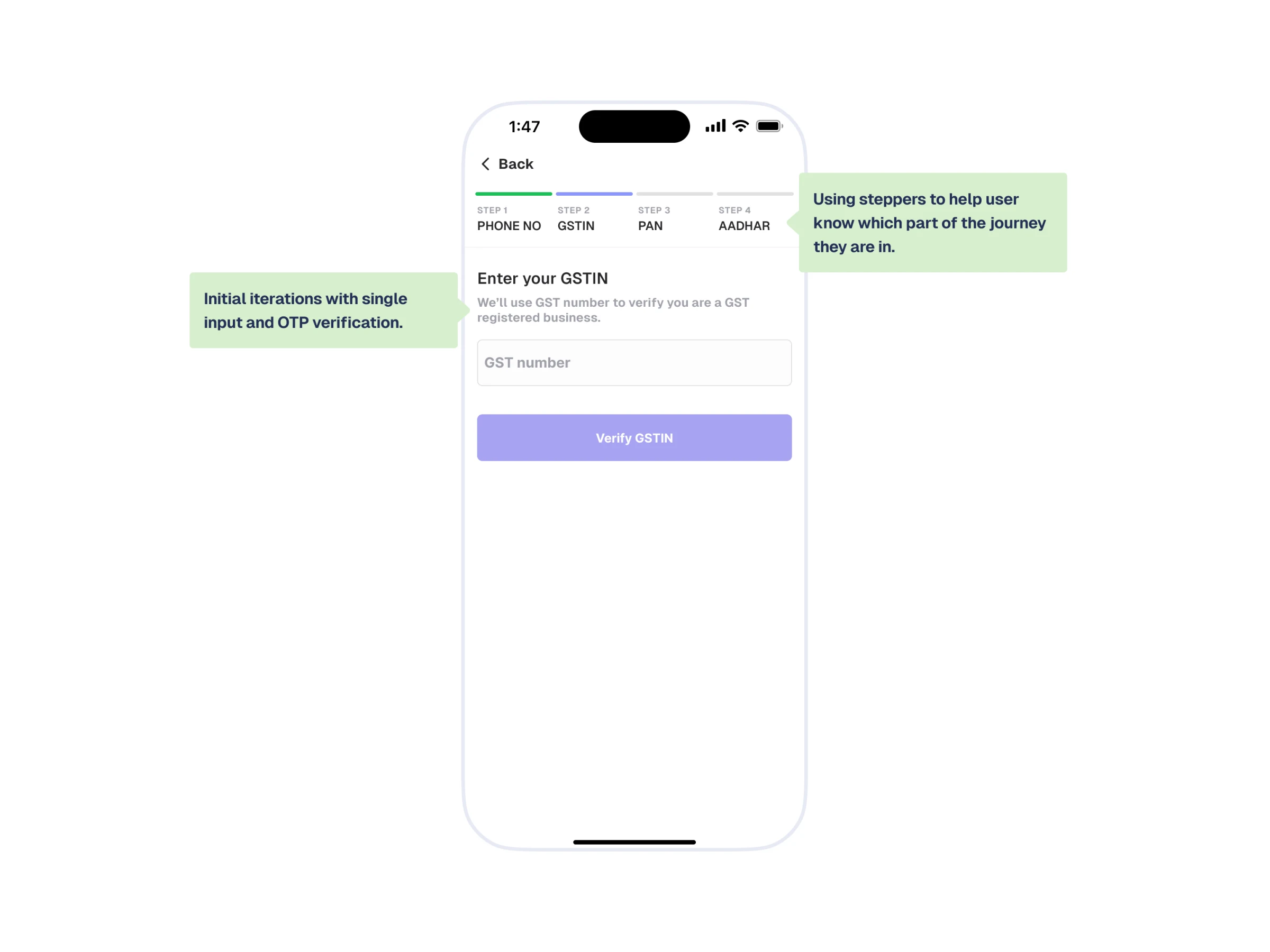
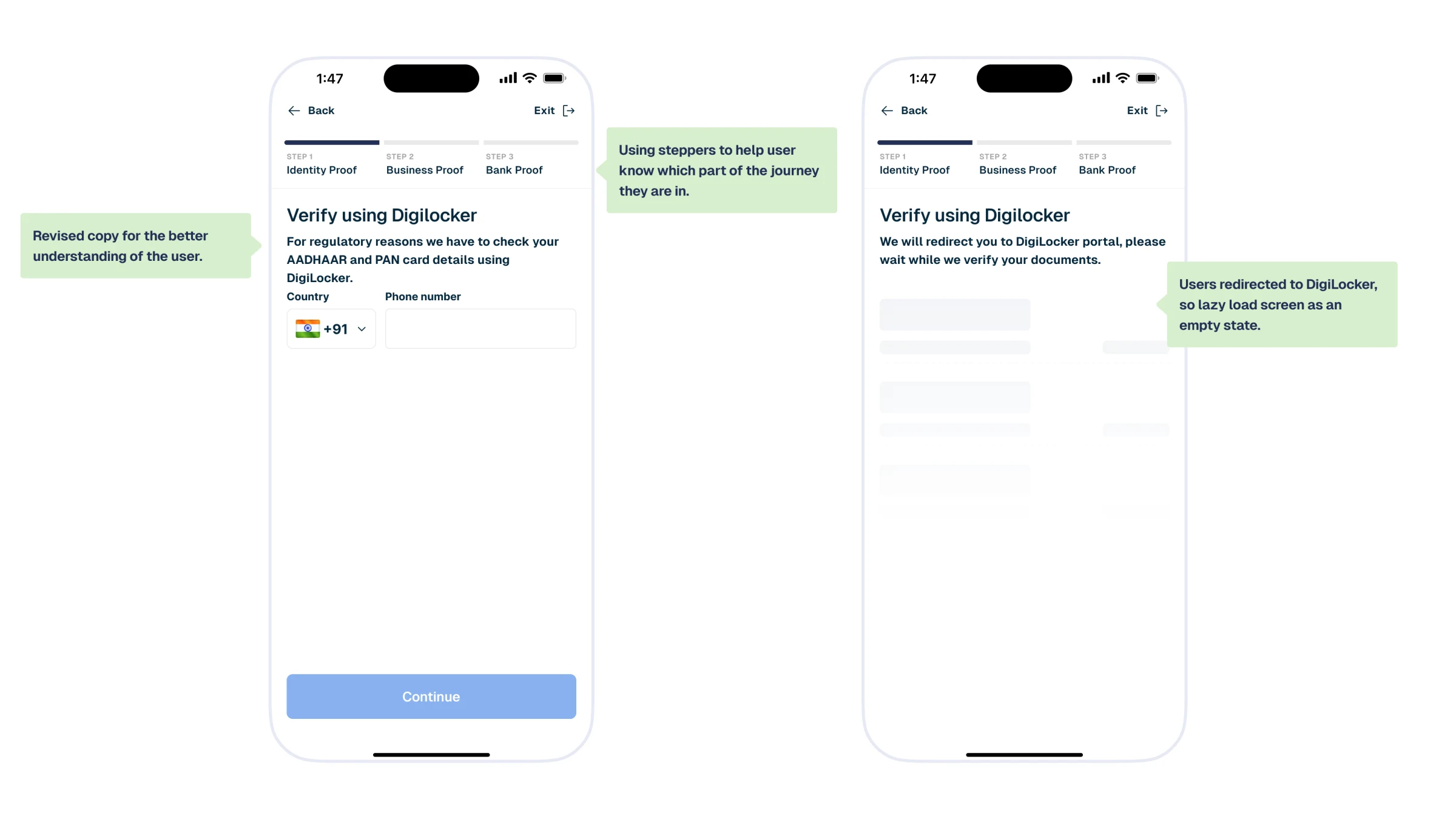
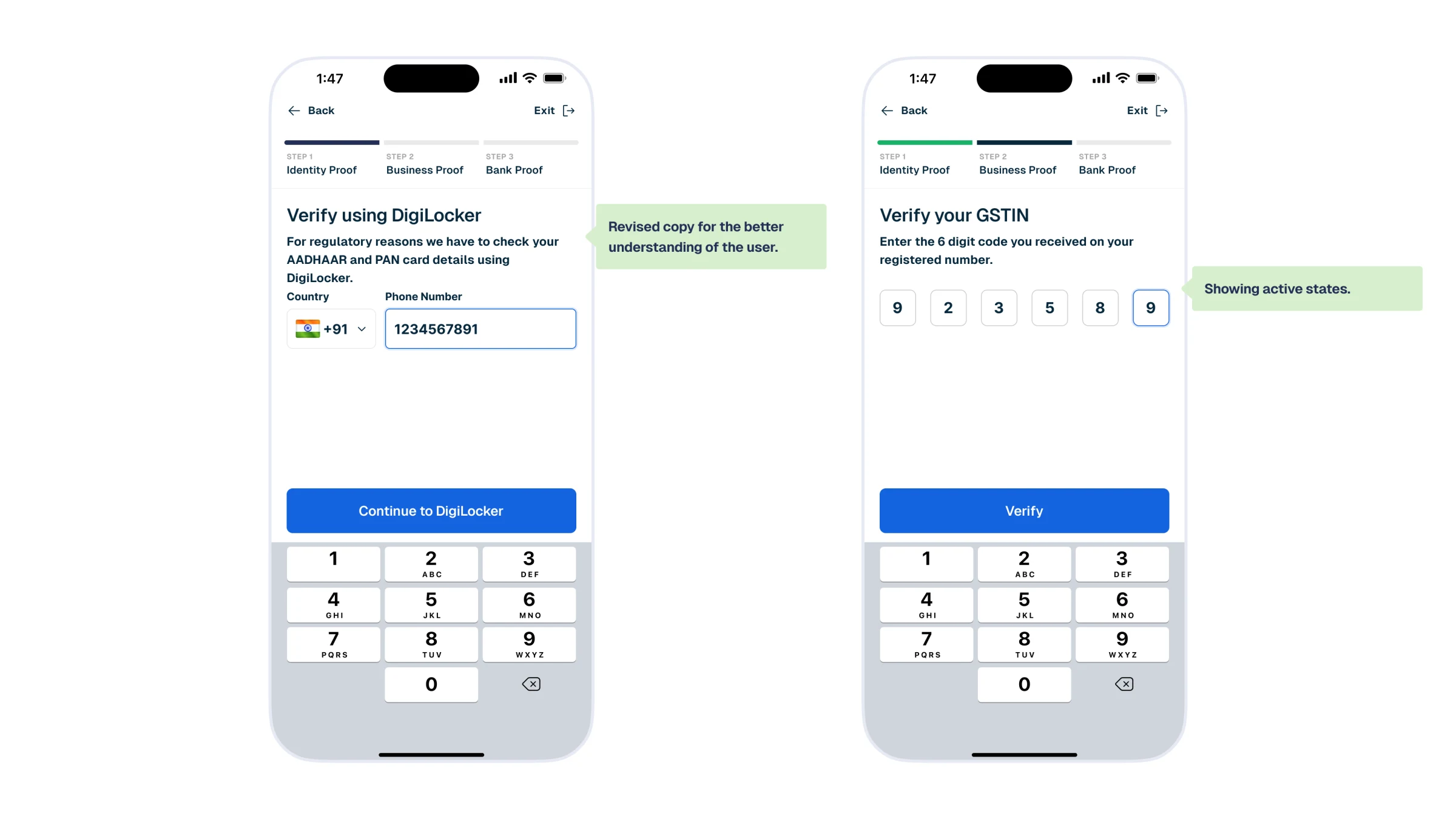
I simplified the copy to help users understand why each piece of information was needed, reducing their confusion and improving completion rates and also grouped the journey into three major sections.
- Identity Proof
- Business Proof
- Bank Proof
Connecting bank account
Next, we get the user’s bank account details. First, we ask them to select the bank to link to the app. Then, we verify it by sending an OTP to their registered phone.
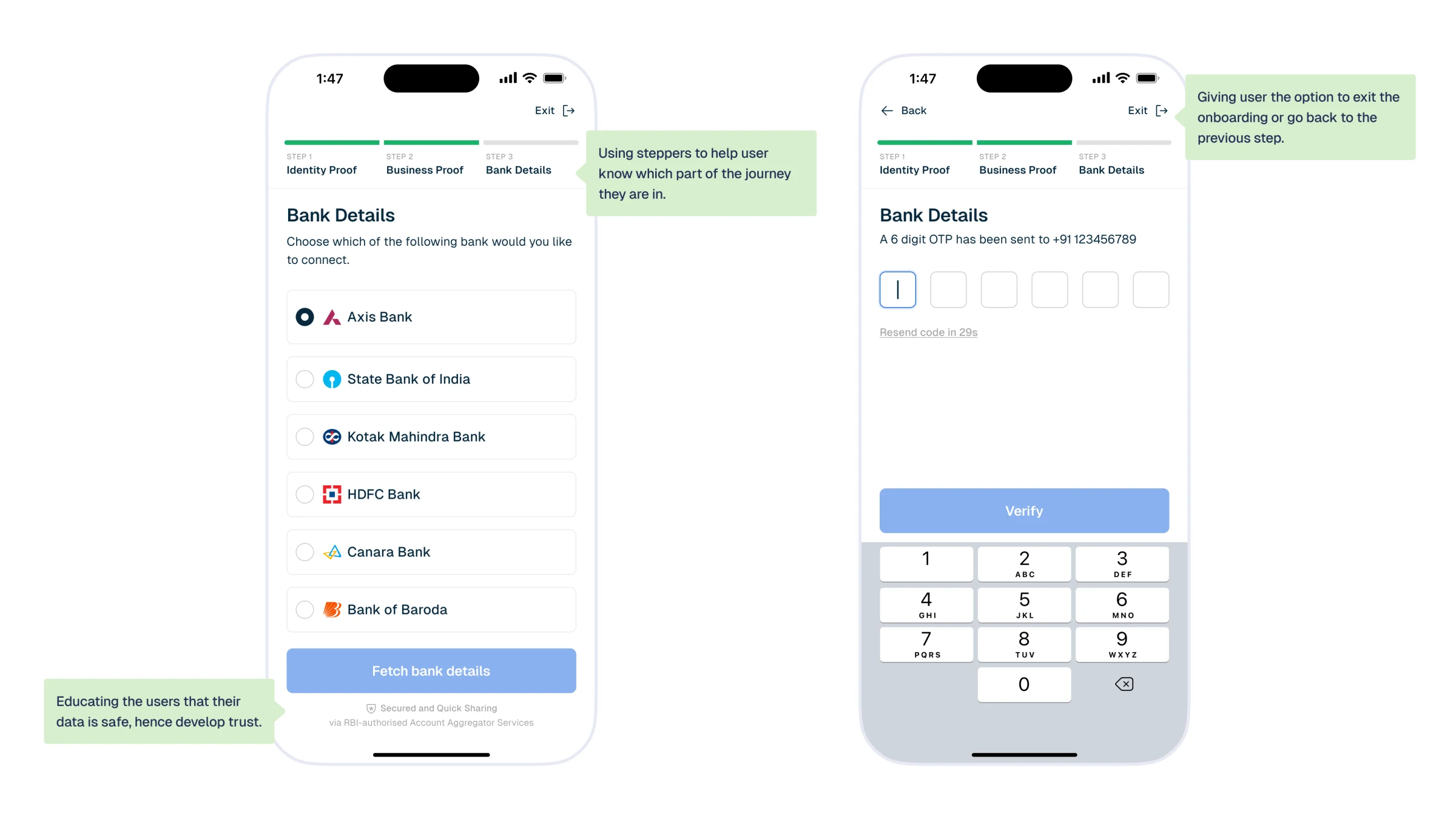
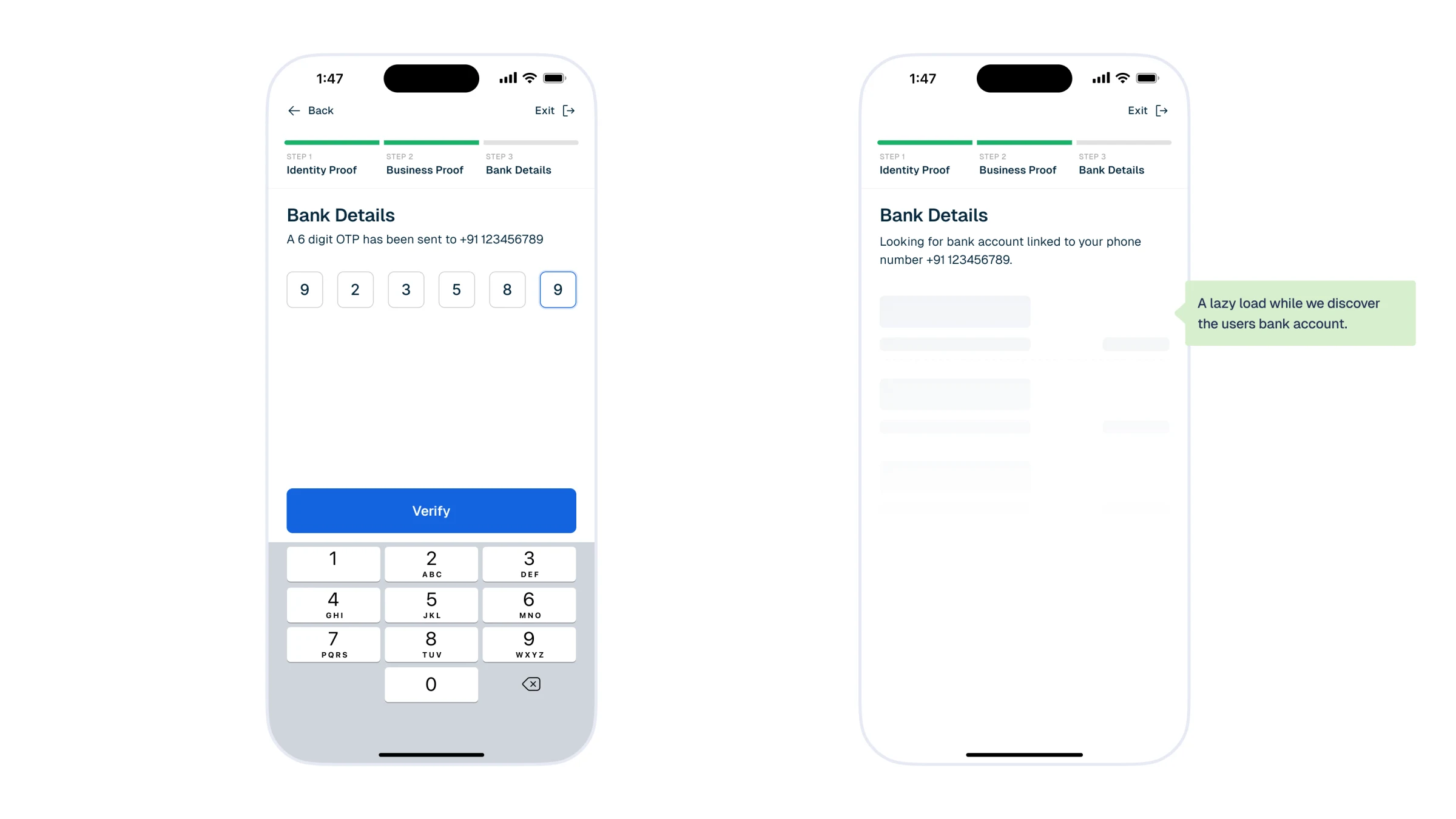
Once we discover and verify the user’s bank account, we take their consent to share the data. We show the user some mandatory parameters. They are: Consent Duration, Consent Date Range, Consent Mode, Fetch Type, Consent Type, Fi Types, Purpose, and Context.
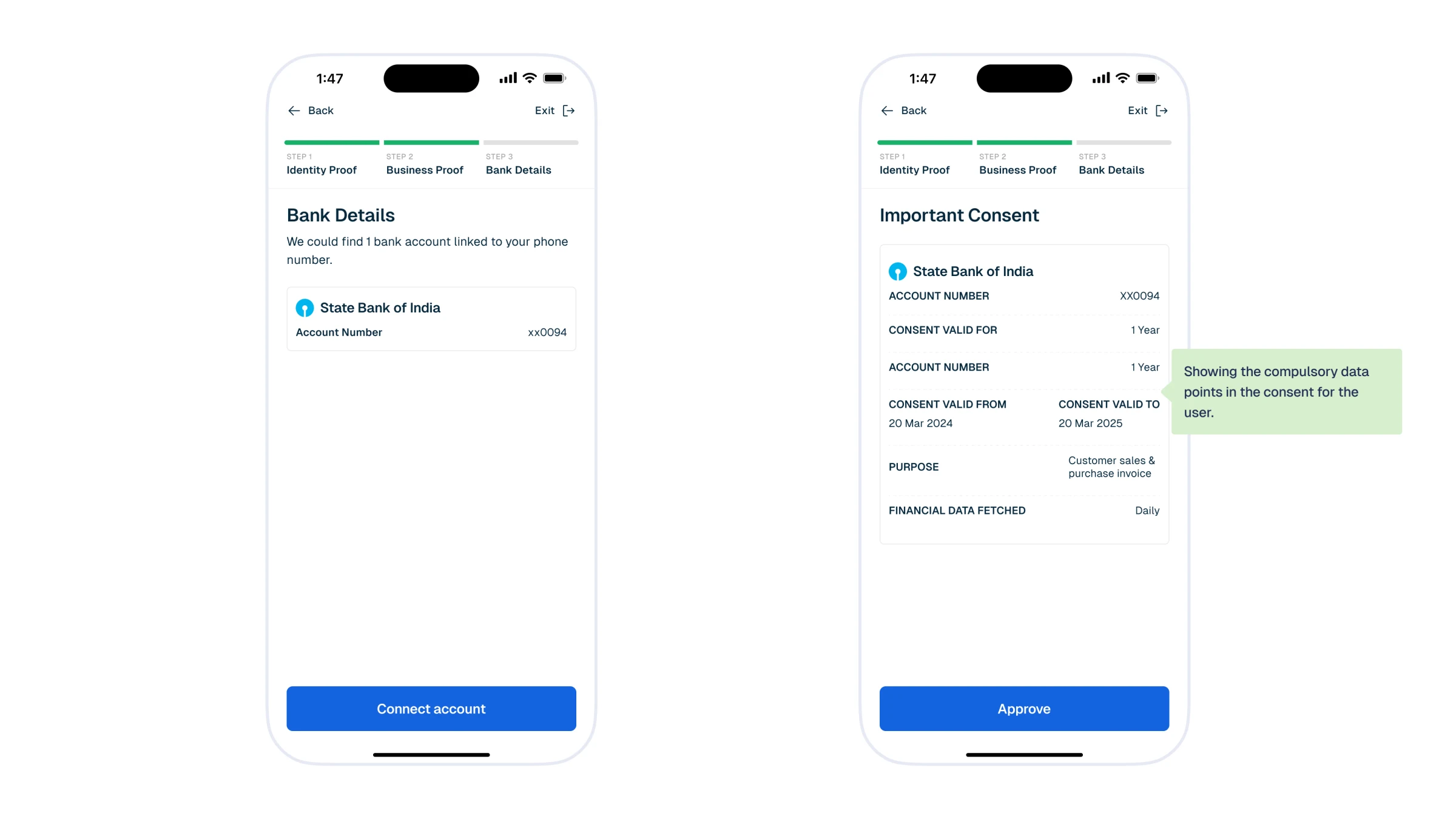
Once the user approves their consent, we take them to the dashboard. There, we show them their sales and purchase invoices.
That is a wrap
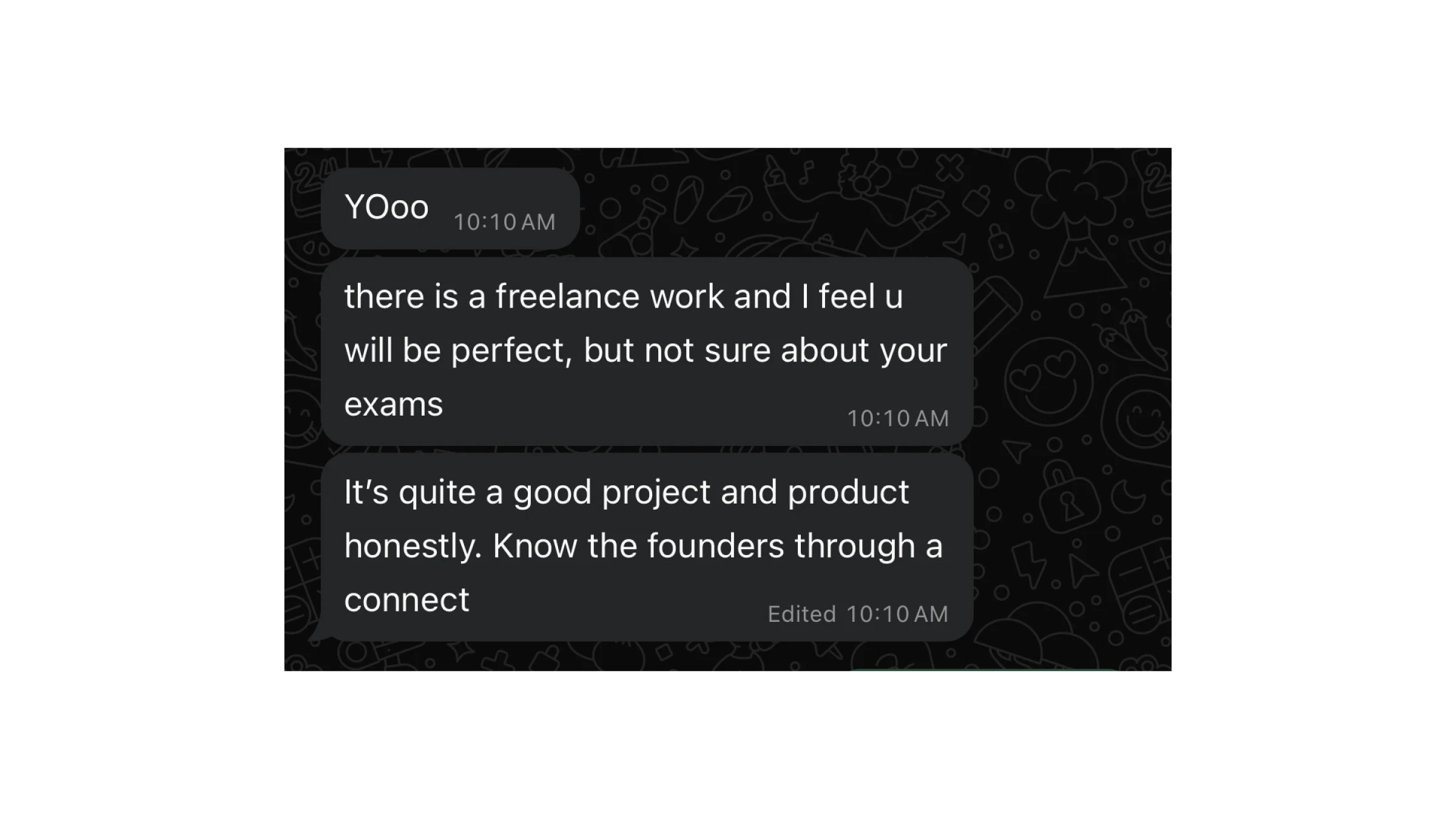
A little background on this project: I got to work on it through Harsh, who connected me to Jainam and Samkit. They are building a startup, InvoiceFlo, in the MSME lending space. On our first call, Jainam said to come to Bangalore to work on this. So, I took the first train there the next morning.
I designed their application and the pitch deck for their Y Combinator application. At the time, my knowledge of lending and account aggregators was limited. After I got back, I researched more about fintechs and reiterated the entire design. Additionally, participating in the Sahamati Buildaathon ’24 provided valuable insights into real-world fintech challenges.
Thanks for reading, working on this project pushed me to learn about the Indian fintech ecosystem which with all its complexity, resonates with me on a profound level. One of my goals five years down the line is to teach young kids, especially young kids, about personal finance which would help them be more aware of their financial choices.
Also, if someone wants to know more about our Indian fintechs and recent developments, here are some resources I used.
- Nikhil Kamath x Nandan Nilekani | People by WTF
- Sahamati Official Website
- D91 Labs — A lot of research based on building for Bharat
P.S: All the gifs I have used here are from the show “The Bear”, one of the cinematic masterpieces.
Thanks for reading till here :)